
Tuesday, 15 November 2011

Understanding the music with Mark
Today's session was held with Kokoro's Conductor, Mark. Who provided great insight into not only the construction of music, but also into the story told purely within the music in 'The Soldier's Tale'. This is one of the most fascinating talks I have had during my degree as although being able to read sheet music and play an instrument I had no idea how music is actually put together. He gave a brief history of how music was formatted throughout the Baroque period using Diatonic scale, (harmonies and tonality) to produce a proportioned and balanced piece of music. Yet this all changed after Wagner rewrote these rules in the late 19th century. Stravinsky is from the Russian School which have their own style of music and his early work reflects this such as 'The Firebird' (1910) and Petruschka (1911). The Firebird being his first collaboration with Diagalev and the Ballet Russe who had a residency in Paris every year. These both received great success yet his Rite if Spring caused controversy with his new style of rhythmic patterns that created an entirely new sound. It is this style where he manipulated the rhythm of the music by polyrhythmic layering that creates an 'offset' out of sync and quite uncomfortable sound that is also used in The Soldier's Tale. This can also be seen within the dances of Tango, Waltz and Ragtime within the piece that are all slightly disjointed and crude sounding. Mark also talked about how Stravinsky collaged the sounds in this work and included elements such as the Trumpets to create the traditional Royal March we all recognise. Elements of the music mimic the scenery such as the picato nature of 'Airs by a Stream'. What I found fascinating was the use of the music to story tell evident throughout such as a mock fanfare for one of the Devil's entrance as he imagines himself as Royalty when he is in fact nothing of the sort. The music is trying to be more sophisticated than it is, as is the Devil; the music painting his mood. It is entrances such as these that the actors will have to be careful with as altering them too much will conflict with the music and look wrong.
Reflection:
Mark's talk has made me want to listen to the music much more not only to get a fuller feel of the story but also to familiarise myself with entrances/exits in the music that may be relevant to costume changes and timings. Mark reitterating that the music is a collage has also made me feel greater confidence in my set design as it ties in flawlessly with my set decoration in the cubist style. I am interested to see how the disjointed music works with the acting style that Doug wants to experiment with - it all seems to be coming together really smoothly and securely - everything interlinking - decoration, visualisation, action and music. Some further points Mark added from viewing the set was not to be afraid to squish up the musicians as they are used to playing in smaller places but also that the Double Bass player has a stool at a special height that she is likely to want to use rather than our chairs that we will have to accommodate. At the moment I am wondering whether we can do this using fabric like the idea for covering the music stands but I shall get in touch and see what she suggests. The chairs must also not be too low and how no arms which Nick already notified me of.
Reflection:
Mark's talk has made me want to listen to the music much more not only to get a fuller feel of the story but also to familiarise myself with entrances/exits in the music that may be relevant to costume changes and timings. Mark reitterating that the music is a collage has also made me feel greater confidence in my set design as it ties in flawlessly with my set decoration in the cubist style. I am interested to see how the disjointed music works with the acting style that Doug wants to experiment with - it all seems to be coming together really smoothly and securely - everything interlinking - decoration, visualisation, action and music. Some further points Mark added from viewing the set was not to be afraid to squish up the musicians as they are used to playing in smaller places but also that the Double Bass player has a stool at a special height that she is likely to want to use rather than our chairs that we will have to accommodate. At the moment I am wondering whether we can do this using fabric like the idea for covering the music stands but I shall get in touch and see what she suggests. The chairs must also not be too low and how no arms which Nick already notified me of.
Prop sourcing
 |
| The Pipe |
Monday, 14 November 2011
First day of Rehearsals
Today was great, not only to be able to present my finalised Set Model to the cast, but to finally feel like the whole project is in motion having begun designing almost 7 months ago now. My designs were well received and I feel like I managed to explain each design and show the operation of the set to it's fullest. I just kept reminding myself of Pamela Howard's advice to 'let you work be your ambassador' every time I felt at all nervous.
The read through was really interesting, finally putting a voice to characters and discovering the actors own perceptions of their character. They are now evolving from the page to life which is fascinating to watch as their characteristics develop, especially when accompanied and completed by the costumes. As the actors had no quibbles with the costume designs I feel I must have represented the characters well as well as them also fitting the actors view of each character. I am now excited to see how they are going to play with cubism in their body movements as the story develops transforming their realistic performance/costumes to relate to the juxtaposed Cubist set.
During the meeting and discussion about props I said that I would like to approve everything before it is bought from the outset so the stage management team have said they will email and picture message me their finds so I can do so. I am very pleased to have established this so early on as the play has such a specific aesthetic both historically and in the Cubist sense that certain props could easily look horribly out of place. I will continue to keep on top of this and help the management team throughout preparations for the show.
The read through was really interesting, finally putting a voice to characters and discovering the actors own perceptions of their character. They are now evolving from the page to life which is fascinating to watch as their characteristics develop, especially when accompanied and completed by the costumes. As the actors had no quibbles with the costume designs I feel I must have represented the characters well as well as them also fitting the actors view of each character. I am now excited to see how they are going to play with cubism in their body movements as the story develops transforming their realistic performance/costumes to relate to the juxtaposed Cubist set.
During the meeting and discussion about props I said that I would like to approve everything before it is bought from the outset so the stage management team have said they will email and picture message me their finds so I can do so. I am very pleased to have established this so early on as the play has such a specific aesthetic both historically and in the Cubist sense that certain props could easily look horribly out of place. I will continue to keep on top of this and help the management team throughout preparations for the show.
Rehearsal Schedule
The Soldier’s Tale
Rehearsal Schedule
Monday, November 14 – Goat and Tricycle (room 2)
1000-1100 mark out and arrival
1100-1300 read through/discussion/games?
1400-1700 Design presentations/read through mock for camera/script work/begin exploring
Tuesday, November 15 – Goat and Tricycle (room 2)
1000-1300 Mark Forkgen to work with actors/musical journey
1400-1700 Mark to work with actors/ Soldier’s March(+reprise 1 and 2), Devil’s Song, Great Chorale/continue exploration
Wednesday, November 16 – Goat room 2
0900-1130 Pages 1-7 – Soldier’s March + dialogue into Airs by a Stream
1200-1330 Doug in meeting at AUCB
1400-1700 Pages 7-11 Airs by a Stream + pages 11-14 dialogue into Soldier’s March reprise 1
Thursday, November 17 – Goat room 2 and Costume Dept.
1000-1330 pages 1-14 + dialogue pages 14-15/run pages 1-15?
1430-1730 Costume fitting in Costume Dept.. Schedule TBC.
Friday, November 18 – Goat room 2
1000-1300 Choreography
1400-1700 Choreography
Monday, November 21 – Goat rooms
1000-1300 Choreography
1400-1700 Pages 15-19 Pastorale 1 and 2 + dialogue
pages 19-23 Airs by a Stream reprise 1 and 2 + dialogue
Tuesday, November 22 – Goat rooms
0930-1200 review pages 15-23? Pages 24-29 Soldier’s March reprise 2 +dialogue
1230-1330 Doug in meeting at AUCB
1400-1700 pages 30-38 Royal March/review day?
Wednesday, November 23 – Goat rooms
1000-1300 1000 TBC. 1100-1300 Choreography
1400-1700 Pages 39-42 Card game dialogue
Thursday, November 24 – Goat rooms
1000-1200 pages 69-74 Devil’s Song, Grande Chorale + dialogue
1230-1400 Doug and Rhiannon at Hope FM interview
1400-1700 1400 TBC. 1500-1700 Choreography
Friday, November 25 – Goat rooms
1000-1300 The Little Concert – pages 43-52
1400-1700 Triumphal March of the Devil
Monday, November 28 – Goat rooms
1000-1300 Work as needed
1400-1700 work through whole play
Tuesday, November 29 – Studio Theatre
1000-1300 work as needed
1400-1700 work as needed. Run through?
Wednesday, November 30 – Studio Theatre
1000-1300 work as needed/choreography??
1400-1700 choreography??
Thursday, December 1 – Studio Theatre
1000-1300 run and work tbc
1400-1700 run and work tbc
Friday, December 2 – Studio Theatre
0900-1300 rehearsals with Kokoro (fittings for Musicians?)
1400-1700 rehearsals with Kokoro/full run through with musicians
Monday, December 5 – Studio Theatre
1000-1300 Costume Parade. Work TBC
1400-1700 Run through. Work.
Tuesday, December 6 – Studio Theatre
1000-1300 TBC
1400-1700 Run through. Work.
Wednesday, December 7 – Studio Theatre and Ocean Room
1000-1300 Run through
1400-1700 work as needed
1800-2200 plotting at Ocean Room?
Thursday, December 8 – Ocean Room Theatre
1000-1300 plotting/tech
1400-1700 Tech rehearsals
1800-2200 Dress rehearsal in costume without musicians
Friday, December 9 – Ocean Room Theatre
0930-1230 full dress with musicians
1330-1500 performance 1 (schools)
2000-2200 performance 2 (opening night)
Saturday, December 10 – Ocean Room Theatre
1700-1830 Performance 3
2000-2200 Performance 4 (closing night)
2200-2400 Get out
Sunday, 13 November 2011
Finalised Set Model

Here is the complete set model as it will be seen set ready for the audience to enter the Theatre space. I am extremely pleased with the look I have achieved all the textures compliment each other nicely and although there isn't a strict colour scheme the selection of deep blue's, soft khaki greens and aged brown look fantastic together and really evoke a time gone by. The Pros arch captures elements of the story and the Soldiers journey from a cubist perspective so are not all entirely obvious - leading the audience to perceive it as they wish. The Pallets not only relate to WWI and provide context but break up the space, create a different level and suggest the long winding road of the Soldiers journey. Furthermore they link into the Orchestra space with the pallet like wooden flooring and corrugated iron edging that mimicks the trenches. The antique chairs they will use help set the context and time period but also add warmth in their selection of browns. The music stands will be masked with fabric that might include a war motif as if they were a war time band. This complete with their uniforms will look fantastic - constantly setting the context of what is happening as the play progresses in another world.
The cubist theme couldn't have worked better - as the play changes scene frequently and swiftly I have incorporated different aspects of the story that are present at all times but suggest each location, such as the meandering stream, sign post, brick wall and the seasonal textures of the Autumnal leaves and the summer corn crop ready to be cut as he travels throughout the country. The painting over the painting is in the cubist style and colour scheme but also shows a great likeness to an aerial view of countryside fields. The collage beneath the painting is of news articles and maps from the era, the maps reinforcing his travel and showing areas at war but also relating to the collage work of Braque and Picasso. The musical notes were also depicted in Cubist works yet I included these also as the music is such an integral part of the storytelling of this tale. Their use of text can also be seen on the pallets, depicting hidden dates, instruments and the name of Ramuz who wrote The Soldiers Tale. Pallets are also used at the back of the Pros stage to suggest the Soldier's home village and it's belfry in the distance which he never quite returns home to as he would wish. In the original stage directions this is not present at all times, however I would like it to be and its presence be brought to attention using lighting at certain points.
The curtains are dust sheet like as if assembled with haste and for a temporray performance, again reflectingthe textures of war time as it will be dirtied down and mud spattered. The curtains will be operated with a pulley system so they can conform to the stage directions.
As for furniture used within the space I have created wooden clad blocks, with some sides painted, that are based on the existing boxes in the acting studio size 50x50x50cm. These can be easily moved around to manipulate/create scenes and pieces of furniture such as the Princess's bed. They will work well as furniture yet also comply to the cubist theme. The Narrator will be sitting to the left of the pros arch (from audience p.o.v) with a stool and cuboid box acting as a table when he is not moving around the set. These stools are also to be used for scenes as they are prefered by the Director are light, easy to move and a good height. The chandeliar, which cannot currently be seen, will drop down for the scenes in the palace to show decadence and alter the dynamic of the space.
Reflection: I am really happy with the final look of the set model, I feel it really presents the character of the story not only on the elements of decoration but the Cubism representing the angst of the era and the sinister presence of the Devil in its juxtaposition of lines and angles. It should comply to budget as I believe the Pallets should not cost a great deal and the other materials such as the iron can also be recycled. It will confirm to Johns specification of fitting in a 20ft lorry as the Pros can break in the centre and at each column for easy transportation. It will either rest on a scaff structure or french braces. I feel like my experimentation with materials and quality of handiwork are high and adhere to reputation of the Orchestra as specified in my learning agreement, as well as being technically accurate and considering budget and technicalities. I have carried out consistent communication with the Director and Orchestra's requirements so it will accommodate their needs and prove a successful set design.
Wednesday, 9 November 2011
Measuring Projection Screen in the Theatre
This visit was well worth it as we did not have any measurements on drawings/photos of the space with the projection screen down. Cally the technician demonstrated the operation of the screen which takes 20 seconds to release/ retract. It can be lowered to any height which is great as it means that with the pallets on the floor this won't pose a problem. I also took the opportunity to take lots of photographs with the projector in the space and its relation to the legs etc. As well as re-visualise my set in the space.
Reflection: Visiting the space is always beneficial in scaling up your ideas from the model box. From this particular visit and adding the screen into my model box I would prefer it if the audience entered the space with the screen up as otherwise parts of the set are viewed but not all of it in a way that looks rather ugly. On speaking to Doug the release of the screen can be coincided with the end of Marks initial talk and the entrance of the Narrator so the audience aren't waiting for the screen but it also doesn't detract from the action, allowing their entrance to see the set in its beautiful entirity which would be ideal.
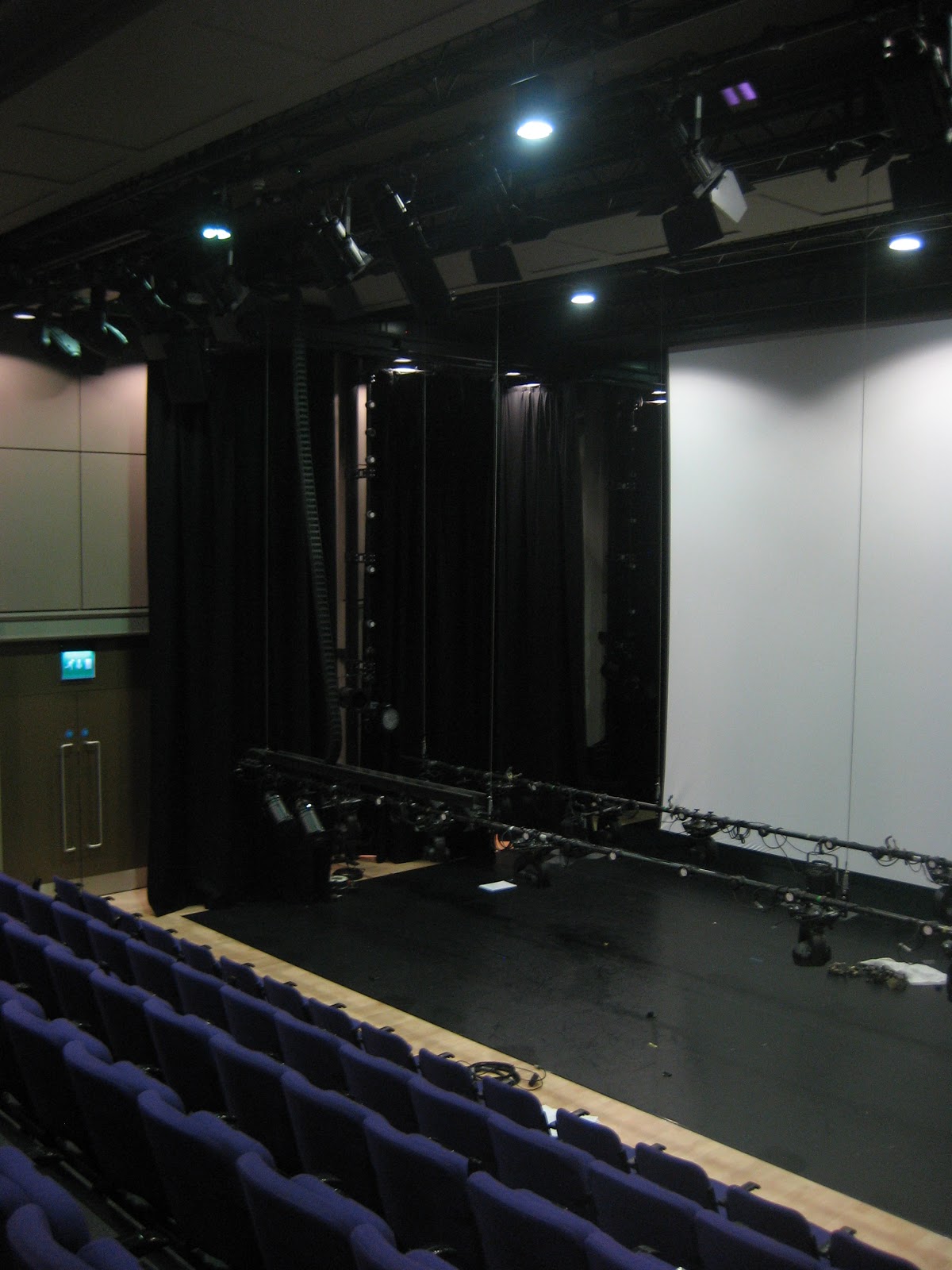 |
| Investigating sight lines from different seats and what will be seen behind the projector in each case. |
 |
| View from the left of the seating - demonstrates how large the screen is in the space. This was with the screen at about 60cm from the ground. |
 |
| Central view |
Subscribe to:
Posts (Atom)